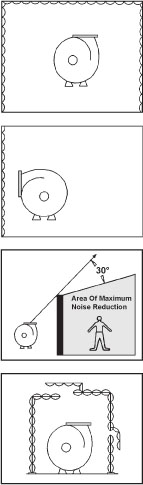
1. Treat the Room
� Maximum noise reduction: 6-9 decibels (30-40% decrease in loudness).
� Advantages: No inconvenience to workers.
� Disadvantages: Almost all of the room must be treated regardless of the size of the noise source.
� QFA Quilted Fiberglass Sound Absorption Products...or Polywrap
� Baffles or Sanitary Baffles, depending upon specifics of application.
2. Treat the Wall Behind the Noise
� Maximum noise reduction: 1-2 decibels if noise source sprays noise out into room, 4-6 decibels if noise is sprayed directly onto wall (such as noisy vent on the back of a machine).
� Advantages: No inconvenience to workers.
� How much QFA? Treat the wall behind the machine with about twice the square footage of the shadow of the machine on the wall.
3. Build a Barrier or Partial Enclosure
� Maximum noise reduction: 6-15 decibels.
� Advantages: Very good noise reduction.
� Concerns: May have to incorporate view windows for visibility and/or sliding panels for access.
� What Size? At a minimum, 8� high. Typically they should be double the height of the noise source.
� BSC or BBC sound absorption/noise barrier composites.
4. Build a Complete Enclosure
� Noise reduction: Up to 20-30 decibels.
� Advantages: maximum noise reduction.
� Concerns: May have to incorporate view windows for visibility and/or sliding panels for access as well as ventilation baffle(s) for air flow.
� BSC or BBC sound absorption/noise barrier composites.
|